14 September 2026 World
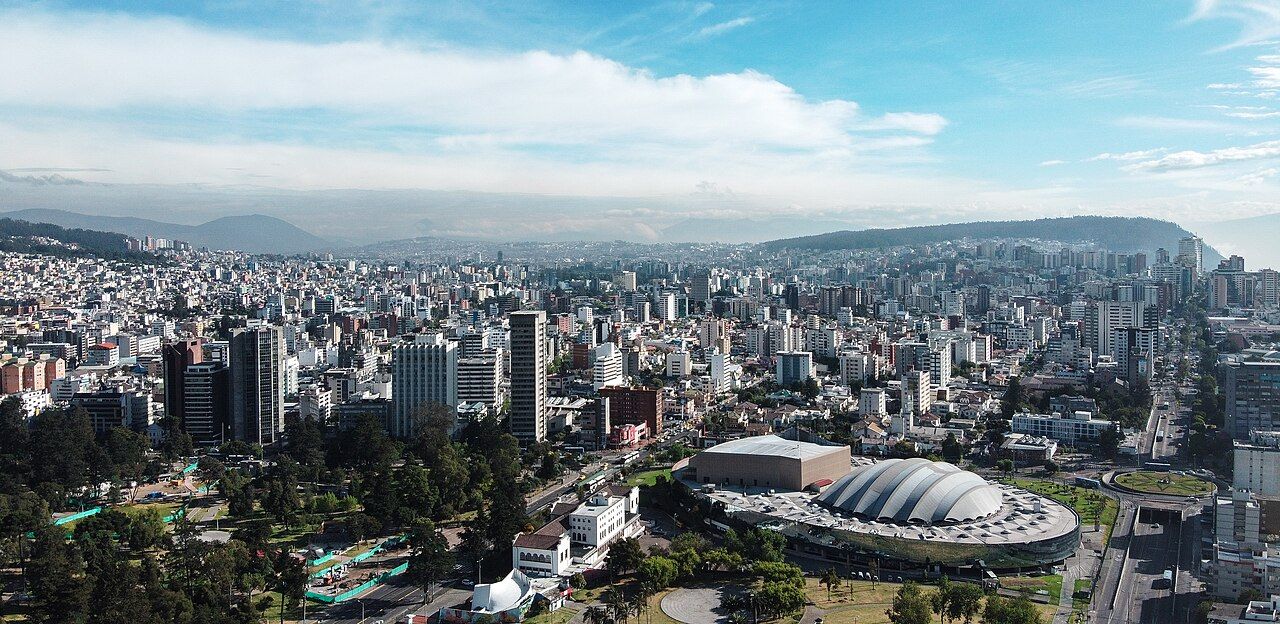
Forest fires threatening Ecuador's capital
Residents of Quito join firefighters in fighting forest fires that threaten residential areas of the Ecuadorian capital.
1 event over the last 60 published days.
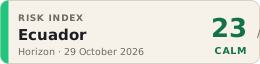
No particular danger for a visitor, and an economic and social situation without notable strain.
Safety 23 + Economy 0 ÷ 2 = 12
The overall score is the average of the two detailed scores below. Each score runs from 0 (nothing to report) to 100 (extreme situation): calm under 30, tension from 30 to 59, crisis from 60. The calculation is fixed and the same for every country: no AI gives its opinion.
What it measures: the danger for someone travelling to the country right now (crime, terrorism, unrest, disasters, epidemics).
What it does not measure: the state of the economy, daily life for residents or long-term political stability.
| Criterion | Today | Scale | Points |
|---|---|---|---|
| Canadian and US travel advisories | “Exercise a high degree of caution (with regional advisories)” · United States: level 2 of 4 | average of both advisories, from 0 (normal precautions) to 70 (do not travel) | 23.3/70 |
| Ongoing disaster (GDACS) | no alert | orange alert 8, red 15 | 0 |
| Reported epidemic (WHO, 30 days) | none | common disease 6, severe disease 10 | 0 |
| Internet outage (IODA) | none | outage 5, major outage 8 | 0 |
| In today's news | not cited | World 2, Geopolitics 4 | 0 |
In short: the score comes from travel advisories (23.3 points out of 70); no ongoing event adds to it.
Where the data comes from: Global Affairs Canada (travel advice) · US Department of State (travel advisories) · GDACS (UN and EU disaster alerts) · WHO (Disease Outbreak News, 30 days) · IODA, Georgia Tech (internet outages) · Horizon briefing of the day.
Score based on advisories written for foreign travellers: it does not describe everyday life there.
What it measures: how fragile the country is: public finances, jobs, prices, lender confidence and protest in the streets.
What it does not measure: the danger for a visitor, nor the future: it is neither a forecast nor financial advice.
| Criterion | Value | Scale | Points |
|---|---|---|---|
| Public debt · what the state owes, relative to a year of output | 54.5% of GDP (2025 value) | 0 up to 60% of GDP, 15 from 150% of GDP | 0/15 |
| Budget deficit · what the state spends beyond its revenue | −2.8% of GDP (2025 value) | 0 from −3% of GDP, 10 at −8% of GDP or below | 0/10 |
| Growth · increase in output | 2.7% | 0 from 2%, 10 at −2% or below | 0/10 |
| Unemployment · share of the labour force without a job | 3.1% | 0 up to 5%, 10 from 15% | 0/10 |
| Inflation · price rise over a year | 2% | 0 up to 3%, 15 from 30% | 0/15 |
| Spread over Germany · extra cost of borrowing over 10 years, a sign of lender confidence | euro area only: not counted for this country | 0 up to 0.5 pt, 20 from 3 pts | — |
| Protests and strikes · in the news over the last 7 days | 0 events in our briefings 1.1% of GDELT events | average of two measures: our briefings (1 event = 6 points, 5 or more = 20) and the share of protests in GDELT (0 up to 2%, 20 from 10%) | 0/20 |
In short: what weighs most is no criterion in particular. Not weighing: public debt, deficit, growth, inflation, unemployment and protests.
Where the data comes from: IMF, World Economic Outlook (2026 forecasts): debt, deficit, growth, inflation, unemployment · ECB, 10-year government bond yields (September 2026), euro area only · GDELT Project (protest events, 7 days) · Horizon briefings of the last 7 days.
Score calculated on 6 of 7 criteria: the points obtained are scaled to 100.
14 September 2026 World
Residents of Quito join firefighters in fighting forest fires that threaten residential areas of the Ecuadorian capital.
Today's risk score, highest first.
You can reuse this index on your website, blog or in your work, as long as you credit Horizon.
Free to reuse, including commercially, crediting Horizon (CC BY 4.0). Full history to download: open data.